
Mathsframe games give children a fun way to practise primary-school maths through interactive browser activities. The platform covers skills including addition, subtraction, multiplication, division, fractions, decimals, percentages, place value, money, geometry and problem-solving.
For parents and teachers looking for maths games that connect with primary-school learning, Mathsframe provides activities for different year groups and mathematical objectives. Children can work through challenges, answer questions, score points and practise specific skills without relying entirely on traditional worksheets.
Whether you’re searching for Mathsframe games online, Mathsframe games free, football-themed activities or multiplication practice, the platform offers different game formats to suit a range of learning needs.
What Are Mathsframe Games?
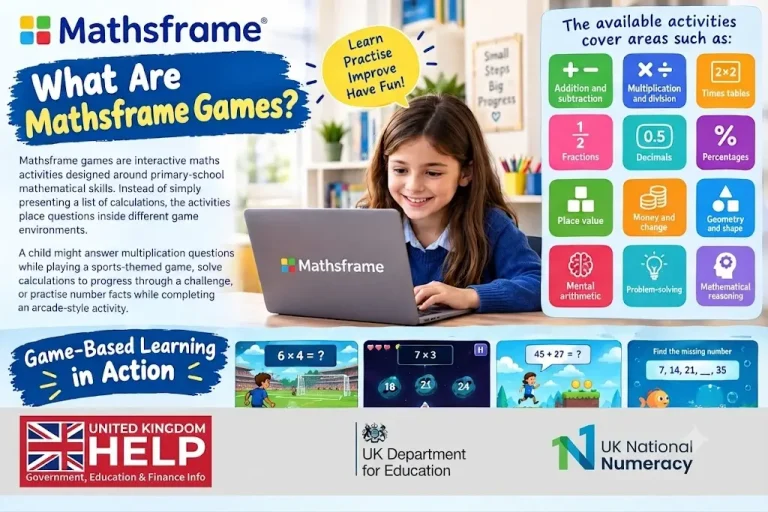
Mathsframe games are interactive maths activities designed around primary-school mathematical skills. Instead of simply presenting a list of calculations, the activities place questions inside different game environments.
A child might answer multiplication questions while playing a sports-themed game, solve calculations to progress through a challenge, or practise number facts while completing an arcade-style activity.
The available activities cover areas such as:
This variety makes Mathsframe games for kids useful when a child needs additional practice but finds repetitive worksheets less engaging.
Helpful tip: Choose the game according to the mathematical skill being practised. A child working on the 7 times table, for example, will usually benefit more from a targeted multiplication activity than from an unrelated maths game.
How Do Mathsframe Games Online Work?
One reason Mathsframe games online are convenient is that they can be accessed through a web browser rather than requiring a separate installation.
A typical session can follow this simple process.
Choose a Maths Topic
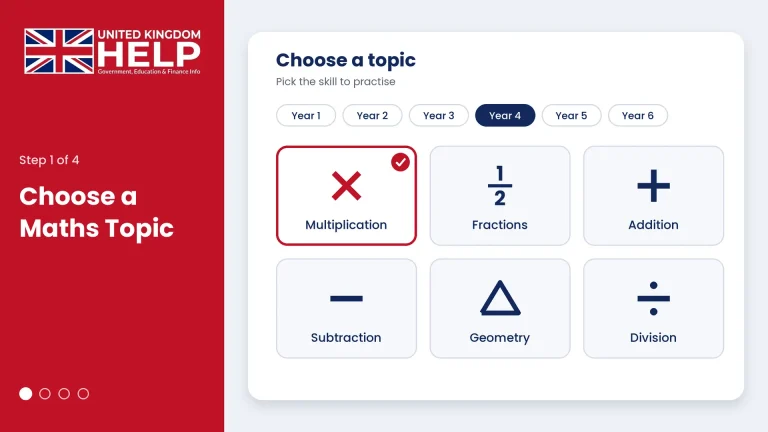
Start by identifying the skill the child needs to practise. Mathsframe includes activities covering multiplication, fractions, addition, subtraction, geometry and other primary maths topics.
You can also use the child’s year group as a guide, from Year 1 to Year 6.
Select an Appropriate Game
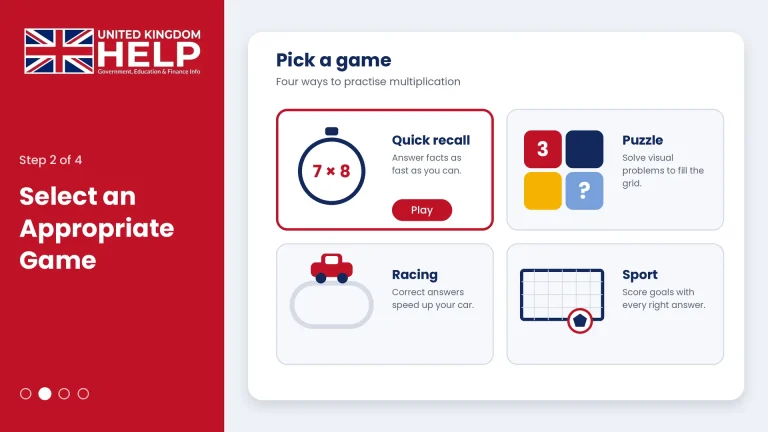
Different activities use different formats. Some focus on rapid recall, while others use visual problems, puzzles, sport or racing-style mechanics.
This means children can practise similar mathematical skills through different types of games.
Focus on a Specific Objective
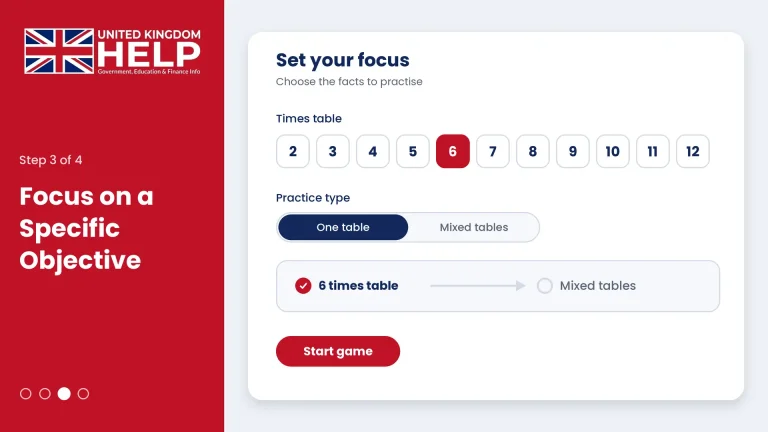
Where the activity provides customisation, choose a particular learning objective or group of facts.
For example, a child might practise one multiplication table before progressing to mixed tables.
Complete the Challenges
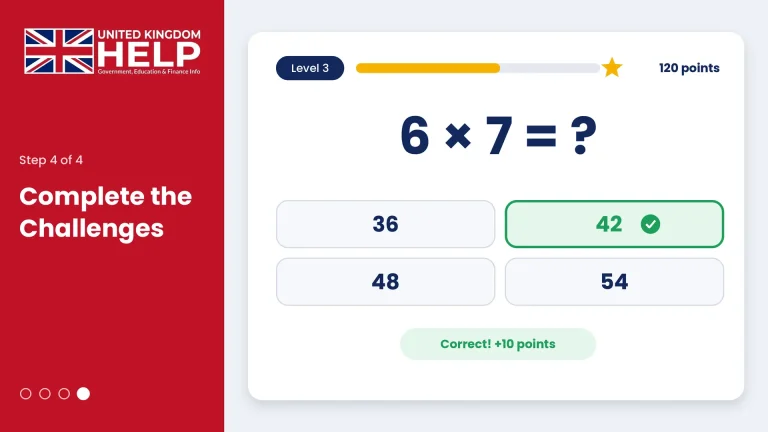
The child answers mathematical questions while progressing through the game. Correct answers may contribute to points, movement, levels or other in-game objectives.
The result is maths practice with an additional goal that can help maintain attention.
Getting Started with Mathsframe Games
One useful feature of browser-based maths activities is that there is little preparation involved. A pupil can open an activity, choose an appropriate topic or challenge and begin practising without installing additional software.
A typical session can follow this pattern:
For younger pupils, a shorter session with a manageable challenge can be more useful than simply increasing the difficulty. Older pupils may benefit from timed activities when the goal is faster recall.
A useful approach for parents and teachers
Don’t treat every game as a test. If a child is still learning a concept, use the activity to reinforce understanding first. Once the underlying skill is secure, timed or more demanding versions can be introduced to develop fluency.
Mathsframe Games to Try
The platform includes different styles of activities, which can help prevent practice from becoming repetitive. Examples include:
| Game | Main style | Useful for |
|---|---|---|
| Tommy’s Trek | Adventure-style maths game | Solving problems while progressing through levels |
| Super Maths Bowling | Sport-themed activity | Arithmetic and target practice |
| Archery Arithmetic | Target-based challenge | Quick and accurate calculations |
| Snowboard Slalom | Timed, action-style activity | Mental agility and rapid responses |
The right choice depends on the skill being practised. A child who needs multiplication recall, for example, may benefit more from a focused times-table activity than from a general arithmetic game.
Finding Activities by Year Group
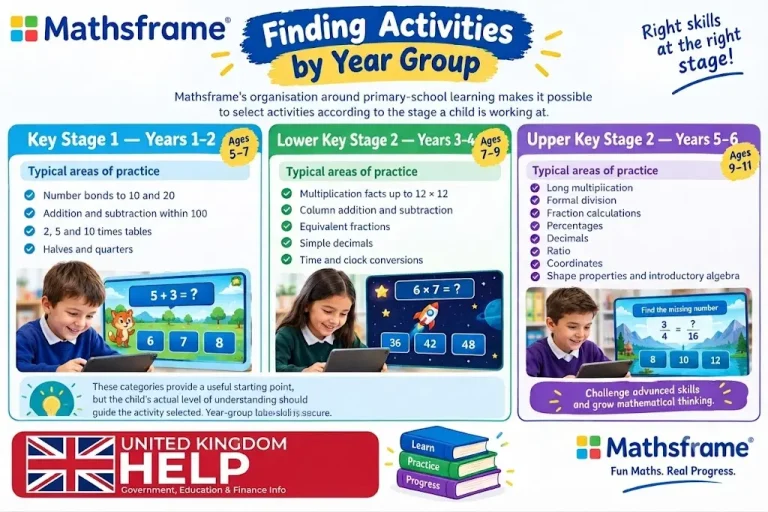
Mathsframe’s organisation around primary-school learning makes it possible to select activities according to the stage a child is working at.
| Stage | Typical areas of practice |
|---|---|
| Key Stage 1 — Years 1–2 | Number bonds to 10 and 20, addition and subtraction within 100, 2, 5 and 10 times tables, halves and quarters |
| Lower Key Stage 2 — Years 3–4 | Multiplication facts up to 12 × 12, column addition and subtraction, equivalent fractions, simple decimals, time and clock conversions |
| Upper Key Stage 2 — Years 5–6 | Long multiplication, formal division, fraction calculations, percentages, decimals, ratio, coordinates, shape properties and introductory algebra |
These categories provide a useful starting point, but the child’s actual level of understanding should guide the activity selected. Year-group labels alone do not always indicate whether a particular skill is secure.
Which Mathsframe Games Can Kids Play?
There are many different types of Mathsframe games for kids, so the most useful choice depends on the child’s age and current learning target.
Some examples include:
| Mathsframe game | Game style | Main practice |
|---|---|---|
| Birds v Robots | Action and challenge | Calculations and rapid recall |
| Maths Penalty Shoot-out | Football | Mental maths and quick responses |
| Stone Age Stu – Times Tables | Arcade adventure | Times tables |
| Super Maths Bowling | Bowling | Mental maths |
| Mini Maths Motors / Golf | Racing and sports | Fast mathematical recall |
The activities are not all designed to develop exactly the same skill. Some are more appropriate for practising recall, while others provide opportunities to apply mathematical knowledge.
Mathsframe Games Football: Learn Maths Through Sport
Children who enjoy football may particularly like Maths frame games football activities such as Maths Penalty Shoot-out.
The basic idea combines mathematical questions with a football challenge. A child answers correctly and then takes part in the associated penalty activity.
This type of format can make repeated mental-maths practice feel more like a game than a traditional test.
Why use a football maths game?
A football-themed activity can be useful when a pupil:
The football theme is the engagement element; the mathematical questions remain the learning task.
Mathsframe Car Game and Racing-Style Activities
Searches for a Mathsframe car game often relate to the platform’s racing-style maths activities, including Mini Maths Motors.
These activities combine mathematical questions with a driving or racing format. The game mechanic gives children an additional reason to concentrate on getting their calculations right.
Racing-style maths games can be particularly useful for pupils who enjoy fast-paced activities, although the same principle applies as with other games: the mathematical objective should come first.
A child who is practising multiplication facts, for example, should use a multiplication-focused activity rather than choosing a racing game simply because they enjoy cars.
Mathsframe Games for Times Tables
Times tables are one of the most common reasons parents and teachers look for Maths frame games.
Regular practice can help pupils become more confident with multiplication facts, particularly when practice gradually moves from individual tables to mixed questions.
Useful approaches include:
Stone Age Stu – Times Tables
Stone Age Stu – Times Tables uses an arcade-style setting to give children repeated multiplication practice.
It can be used when a pupil needs to revisit multiplication facts and build greater fluency.
Multiplication Miner
Multiplication Miner asks pupils to identify factors that produce a particular product.
This changes the task slightly from simply answering a multiplication equation and can encourage children to think about the relationship between factors and products.
Parachute Multiplication
Parachute Multiplication combines multiplication practice with number-line and scale-related elements.
Using more than one type of activity can prevent times-table practice from becoming overly repetitive.
Mathsframe MTC and Multiplication Tables Check Practice
Mathsframe MTC resources can be useful for pupils preparing for the Year 4 Multiplication Tables Check (MTC).
The multiplication tables check focuses on rapid recall of multiplication facts. Practice activities can therefore give pupils opportunities to become familiar with answering multiplication questions accurately and efficiently.
How to use Mathsframe for MTC preparation
A balanced practice routine could include:
| Practice type | Purpose |
|---|---|
| Individual tables | Strengthen weaker multiplication facts |
| Mixed tables | Check recall across different facts |
| Untimed practice | Prioritise accuracy |
| Timed practice | Develop faster recall |
| Review | Identify recurring mistakes |
The aim shouldn’t be to make every session a speed test. Children first need secure multiplication knowledge. Once accuracy is improving, timed practice can help develop fluency.
Is there Mathsframe multiplication check free practice?
Where free multiplication activities are available, they can provide additional opportunities to practise multiplication facts without requiring a full subscription.
For families searching specifically for Mathsframe multiplication check free resources, it is worth distinguishing between individual free games and the platform’s wider subscription features. Access to particular activities and management tools can vary.
A Simple Times Tables Practice Routine
A short, structured routine can be more useful than repeatedly playing the same timed game.
Learn
Choose a specific multiplication table or group of facts.
Practise
Use an untimed activity to reinforce accuracy.
Mix
Introduce questions from several tables once individual facts are becoming secure.
Time
Add a speed element when rapid recall is the goal.
Review
Look at incorrect answers and return to the facts that caused difficulty.
This approach keeps Maths frame games connected to a clear learning objective rather than treating the highest game score as the only measure of progress.
Mathsframe Games by Year Group
Mathsframe activities can be selected according to the mathematical content pupils typically encounter at different stages of primary school.
| Year group | Common areas of learning | Potential game focus |
|---|---|---|
| Years 1–2 | Counting, number bonds to 10 and 20, 2, 5 and 10 times tables, basic shapes | Counting, matching and introductory speed activities |
| Years 3–4 | Times tables to 12 × 12, written calculation, fractions and four-digit place value | Multiplication, times tables and fraction activities |
| Years 5–6 | Decimals, percentages, prime numbers, multi-step problems, measurement and algebra | More advanced calculation, conversion and problem-solving activities |
These are useful starting points rather than fixed boundaries. A pupil may need to revisit an earlier skill or be ready for a more challenging activity.
Mathsframe Games for Addition and Subtraction
Not all Maths frame games are focused on multiplication. Addition and subtraction activities can help children practise number relationships, mental strategies and formal calculation.
Number-line practice
Number-line activities can demonstrate how numbers move forwards or backwards. For example, pupils can explore strategies such as adding 30 and then subtracting 1 when calculating 29.
Balancing calculations
Some activities place incomplete calculations on both sides of an equals sign.
This helps reinforce an important mathematical idea: the equals sign represents a relationship between two quantities, rather than simply meaning that an answer comes next.
Money and change
Money-based activities apply addition and subtraction to pounds and pence.
This gives pupils a practical context for calculations and can help connect classroom maths with everyday situations.
Mental arithmetic
Interactive questions can provide repeated practice with number bonds, simple additions and other mental calculation strategies.
Written methods
Visual activities can also support formal addition and subtraction, including calculations requiring regrouping.
However, games should reinforce a method that has already been explained and modelled. They aren’t a replacement for teaching the underlying calculation.
Word problems
Problem-solving activities add another layer because pupils must first identify the operation needed.
For example, a child may know how to add two numbers but still need to decide whether addition, subtraction, multiplication or division is appropriate in a word problem.
Multiplication and Division Games
Multiplication and division should not be treated as completely separate areas. Understanding their inverse relationship helps pupils use known facts in different ways.
For example:
6 × 7 = 42
means that:
42 ÷ 6 = 7
and:
42 ÷ 7 = 6
Activities that present related multiplication and division facts can therefore support understanding as well as recall.
Division with remainders
Division activities can introduce grouping and leftover quantities, helping pupils build towards more formal work with remainders.
Scaling multiplication
Known multiplication facts can also be connected to larger values.
For example:
3 × 4 = 12
can support understanding of:
30 × 40 = 1,200
This links multiplication with place value rather than treating each calculation as an isolated fact.
Mathsframe Games for Fractions
Fractions can become easier to understand when pupils can see the relationship between a part and the whole.
Relevant activities can involve:
For example:
¼ = 0.25 = 25%
Seeing these forms together helps children recognise that they represent the same quantity.
A visual approach to fractions
| Fraction skill | Possible activity format | Learning focus |
|---|---|---|
| Recognising fractions | Shaded shapes and visual models | Parts of a whole |
| Equivalent fractions | Matching activities | Equal values |
| Fraction calculations | Visual representations | Combining quantities |
| Fractions of amounts | Grouping and sharing | Finding part of a number |
| Conversions | Matching equivalent values | Fractions, decimals and percentages |
Fractions often require more explanation than simple recall activities. If a pupil repeatedly chooses incorrect answers, slowing down and returning to a visual representation may be more useful than increasing the game speed.
How Teachers Can Use Mathsframe Games
Teachers can use Maths frame games at different points during a maths lesson.
Lesson starters
A short game can provide a two- or three-minute mental maths warm-up at the beginning of a lesson.
Targeted practice
Instead of giving every pupil the same activity, teachers can select tasks that relate to individual learning objectives.
Independent work
Interactive games can provide additional practice after the mathematical concept has been taught.
Homework
Where subscription features allow it, teachers can assign activities for pupils to complete outside the classroom.
Identifying learning gaps
Assessment activities can help highlight areas that require additional teaching or practice.
A practical classroom sequence
Explain → Model → Practise → Play → Review
The teacher first introduces the mathematical idea, pupils practise it, the game reinforces the skill, and mistakes are then discussed.
This keeps the technology in its proper role: supporting mathematical learning rather than replacing instruction.
How Parents Can Use Mathsframe Games at Home
Maths frame games for kids can also provide supplementary practice outside school.
Parents don’t need to turn every session into a formal lesson. A short activity linked to something the child is currently learning can be enough.
Try this approach:
Talking about the answer is especially useful. A child may select the correct option without fully understanding the calculation, while an incorrect answer can reveal exactly where additional teaching is needed.
Are Mathsframe Games Free?
There are Maths frame games free to access, alongside additional features available through paid teacher, school or parent subscriptions.
The distinction is important because free games and subscription services don’t necessarily provide the same level of access or management.
| Feature | Free activities | Subscription features |
|---|---|---|
| Interactive maths games | Available | Available |
| Online browser practice | Available | Available |
| Wider game library | More limited | Broader access |
| Pupil accounts | — | Available |
| Progress tracking | — | Available |
| Assigned tasks | — | Available |
| Teacher/parent management | — | Available |
The exact features depend on the subscription type.
Why Use Maths Games Online?
Maths games online can give children a different way to repeat skills they have already been taught.
The biggest advantage isn’t simply entertainment. Interactive activities can provide repeated questions, immediate responses and a clear objective while giving children a different experience from a worksheet.
They can be especially useful for:
The activity still needs to match the learning goal. A game is most useful when the mathematical content is appropriate for the pupil.
Common Mistakes When Using Mathsframe Games
Making every activity a speed test
Not every mathematical skill needs to be completed quickly. Fractions, word problems and newly introduced methods may require time for reasoning.
Choosing a game only because it looks fun
Entertainment can encourage engagement, but the mathematical objective should remain the priority.
Focusing only on scores
A high score doesn’t necessarily show complete understanding. Look at the questions a pupil gets wrong and identify recurring patterns.
Using games instead of teaching
Maths frame games work best as practice and reinforcement. Explanation, modelling and mathematical discussion are still important.
Staying at one difficulty level
As a child’s accuracy improves, gradually introduce mixed questions or more demanding tasks.
How to Get More From Mathsframe Games
The most effective use of Mathsframe games is purposeful rather than simply letting a child play indefinitely.
Before starting, identify the skill that needs practice. During the activity, pay attention to accuracy as well as speed. Afterwards, use mistakes to decide what the child should revisit.
A simple routine is:
Choose the skill → Select the game → Practise → Review mistakes → Repeat or progress
Whether you’re using Mathsframe games free activities at home, preparing for the Mathsframe MTC practice, looking for Maths frame games for kids, or using football and racing activities to make maths more engaging, the mathematical objective should remain at the centre of the session.
The game provides the setting. The real goal is stronger mathematical understanding and fluency.
Frequently Asked Questions
Conclusion
Maths frame games can turn regular maths practice into a more interactive and engaging learning experience. With activities covering times tables, multiplication, division, fractions, addition, subtraction, mental maths and problem-solving, children can practise different skills through game-based activities.
The key is to choose each activity with a clear learning goal in mind. Mathsframe games for kids can support classroom practice, homework, MTC preparation and extra learning at home, while football, racing and arcade-style formats can provide variety.
Whether you choose Maths frame games online, explore Maths frame games free, practise with Mathsframe MTC activities or use a specific Mathsframe car game or football activity, the game itself is only part of the learning process. The most useful sessions combine practice with explanation, review and discussion so children can build both mathematical fluency and understanding.
Read more