
If you need to pass the Life in the UK Test for British citizenship or settlement, Life in the UK Test Booking through the correct government service is the first step. The process is completed online, costs £50, and you must book your test at least 3 days in advance.
This Life in the UK Test Booking guide explains what you need before booking, how to select a centre and appointment, what identification is accepted, and what to do if you need to change your booking. It also explains how Life in the UK Test Practice and Life in the UK Test Questions can help you prepare before your appointment.
Quick answer: The Life in the UK Test costs £50. You need an email address, a debit or credit card and accepted identification to book. The name entered during booking must exactly match the ID you use. You must book at least 3 days before the test.
Who Needs to Take the Life in the UK Test?
The test may be required when you apply for British citizenship or settlement in the UK. Whether you personally need to take it depends on your immigration or citizenship application, so check the requirements for your specific application before you book the Life in the UK Test.
Some people do not need to take the test. GOV.UK currently lists people who are under 18, people aged 65 or over, people who have already passed the test, and certain people with a long-term physical or mental condition for which an exemption can apply.
Passing the Life in the UK Test is not the same as receiving settlement or citizenship. Instead, it provides evidence that you have met the Life in the UK knowledge requirement where that requirement applies.
Life in the UK Test Booking: What You Need First
Before starting your Life in the UK Test Booking, have the following ready:
The identity requirement deserves particular attention. GOV.UK says the name entered for the booking must be an exact match with the name on the identification document used for the booking.
That means you should check spelling, order of names and any other details before paying. A small difference can create problems when you attend the test because the centre must verify your identity.
Accepted ID for the Booking
The current GOV.UK rules allow several forms of identification, depending on your circumstances. These include:
If you use an eVisa, you should access your UK Visas and Immigration account and obtain the appropriate share code. GOV.UK has specifically updated its guidance to allow an eVisa share code to be used as evidence of identity for the Life in the UK Test.
There are also transitional rules for expired BRPs and BRCs. The current guidance says these may be usable for up to 24 months after the expiry date printed on the card, or until 31 December 2026, whichever comes first.
Because identification rules can change, check the official requirements immediately before your appointment rather than relying on an old checklist.
How to Book the Life in the UK Test Online
The Life in the UK Test Booking process is handled through the official government service rather than a private booking company. If you want to book Life in the UK Test, always start from GOV.UK.
Step 1: Open the Official GOV.UK Service
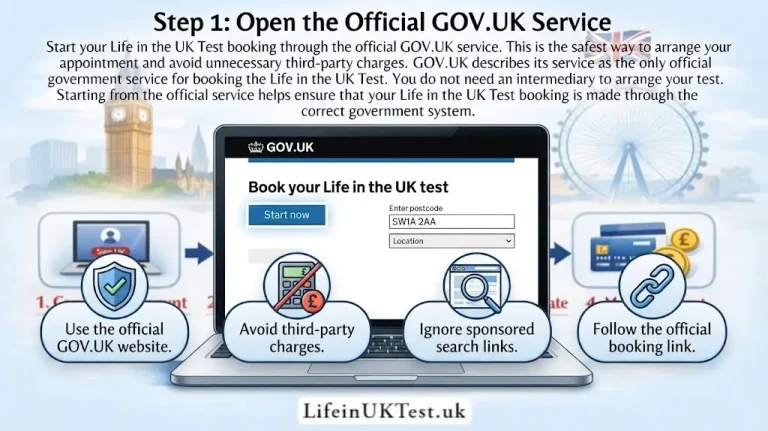
Start your Life in the UK Test booking through the official GOV.UK service. This is the safest way to arrange your appointment and avoid unnecessary third-party charges.
GOV.UK describes its service as the only official government service for booking the Life in the UK Test. You do not need an intermediary to arrange your test.
Before continuing:
Starting from the official service helps ensure that your Life in the UK Test booking is made through the correct government system.
Step 2: Prepare Your Personal Information
Once you open the booking service, you will need to enter your personal information. Take your time at this stage because the details you provide should correspond with your accepted identification.
It is a good idea to keep your original ID document beside you while completing the form. This makes it easier to enter your name and other details accurately.
Before continuing, check:
Do not rely on memory when entering your information. If your passport or other identification contains middle names or a different spelling from the name you normally use, copy the details exactly as required by the booking service.
Step 3: Select a Test Centre
During your Life in the UK Test booking, you can choose the test centre where you want to take the exam. GOV.UK currently states that there are over 30 test centres across the UK, giving candidates several options.
You do not necessarily have to choose the centre closest to your home. If your preferred location does not have a suitable appointment, checking another nearby town or city may give you more flexibility.
When comparing test centres, consider:
An earlier appointment is not always the best option if the journey is difficult. Choose a location that you can reach comfortably and reliably.
Step 4: Pick an Appointment
After selecting your test centre, you can choose an available date and time. Think carefully about the appointment you select rather than simply choosing the earliest available slot.
The booking must be made at least 3 days in advance, so you should not leave your Life in the UK Test booking until the last minute.
Before selecting your appointment, consider:
If you are working towards a citizenship or settlement application, it is sensible to leave enough time between your test and your application deadline. This gives you some flexibility if you need to deal with an unsuccessful attempt or an unexpected booking problem.
Step 5: Pay the £50 Test Fee
Once you have selected your centre and appointment, you will need to pay the official test fee. The current Life in the UK Test fee is £50 per test, and payment is made online using a debit or credit card.
Before completing the payment, carefully review your booking information. Make sure your selected date, time and test centre are correct.
Remember:
Taking a moment to review everything before paying can help prevent avoidable booking mistakes.
Step 6: Keep Your Booking Information
Once your Life in the UK Test booking has been completed, keep your confirmation information somewhere safe. Your confirmation contains important details about your appointment and should be available when you need to check your arrangements.
After booking, check your email and make sure you have the relevant appointment information.
Keep a record of:
If you are uncertain about your appointment, use the official account or contact the Life in the UK Test Helpline rather than relying on an unofficial website.
GOV.UK currently lists the helpline as 0800 015 4245, Monday to Friday, 8am to 8pm.
Keeping your Life in the UK Test booking information safely stored means you can quickly check your appointment details and avoid confusion before test day.
Life in the UK Test Fee and Booking Timing
| Booking detail | Current requirement |
|---|---|
| Test fee | £50 |
| Booking method | Online |
| Minimum advance booking | At least 3 days |
| Test centres | Over 30 |
| Questions | 24 |
| Test duration | 45 minutes |
| Pass mark | 75% or more |
The Life in the UK Test contains 24 questions and gives you 45 minutes to complete them. A score of at least 75% is required to pass.
The questions are based on the official Life in the UK handbook, so preparation should focus on that source rather than relying entirely on unofficial question banks.
Using Life in the UK Test Questions and practice tests can help you become familiar with the multiple-choice format, but your main preparation should remain based on the official handbook.
Choosing the Right Date for Your Test
A good Life in the UK Test Booking is not simply about finding the earliest available appointment. Your chosen date should give you enough time to prepare properly and still fit your wider immigration plans.
If you have not studied the official handbook yet, avoid booking an unnecessarily early appointment just because a slot is available. On the other hand, waiting too long can create pressure if you need your test result for a future settlement or citizenship application.
GOV.UK confirms that candidates are tested only on information from the official Guide for New Residents, which is available in book, eBook and audio formats.
Practical tip: Before paying, check three things: your ID, the spelling of your name and the appointment date. Those simple checks can prevent avoidable problems later.
What Happens After You Pass?
A successful test gives you a unique reference number. You need this number when completing a citizenship or settlement application, because the Home Office uses it to verify that you passed the test.
Keep this information safe after your test. It can become an important part of the evidence you provide during the later immigration or citizenship process.
The Life in the UK Test is therefore best viewed as one stage in a wider application journey, rather than as the application itself.
Life in the UK Test Booking: Changing or Cancelling Your Appointment
Plans can change after you complete your Life in the UK Test Booking. You may need to move the appointment, cancel it, or deal with a problem before test day. The key point is to use the official booking service and check the current cancellation and refund terms before making a change.
The official GOV.UK page is the best starting point for your booking and support:
Can You Reschedule a Life in the UK Test?
If you can no longer attend on your selected date, check your booking through the official test service and follow the available instructions for changing the appointment.
Your original booking information is important, so keep your confirmation details available when requesting a change. The government requires tests to be booked at least 3 days in advance, so avoid leaving changes until the final hours before an appointment.
A useful approach is:
Important: The exact cancellation, rearrangement and refund conditions should be checked against the current official terms rather than relying on advice from an unofficial website.
Cancelling Your Life in the UK Test Booking
There are situations where cancelling is more suitable than moving your appointment. Before cancelling, check the official cancellation and refund rules because the amount you may receive back can depend on when you cancel.
Do not assume that every late cancellation will automatically receive a full refund.
The GOV.UK service provides a dedicated section for cancellations, refunds and complaints, so use that official information if you need to cancel or have a problem with your booking.
Before You Cancel
Check these details first:
If your problem is technical rather than personal, contacting the official Life in the UK Test Helpline may be more appropriate than cancelling immediately.
Life in the UK Test Booking Confirmation
After making a Life in the UK Test Booking, keep your confirmation information safe. It is useful to have the appointment details available before travelling to the test centre.
Check your email after booking and look carefully at:
If you do not receive the expected information, check your junk or spam folder first. If you still cannot resolve the issue, the official helpline can help with booking questions.
The GOV.UK Life in the UK Test Helpline is currently:
Telephone: 0800 015 4245
Email: [email protected]
Opening hours: Monday to Friday, 8am to 8pm
Use official GOV.UK information when checking contact details because third-party websites can display outdated numbers.
What to Bring to the Life in the UK Test
Your Life in the UK Test Booking is only one part of preparing for test day. Identification is particularly important because the document you bring must correspond with the information used during registration.
The official identification guidance states that you must bring the same original identification document used to register and book the test. Copies and screenshots are not accepted.
Your Original ID Is Essential
On the day of the test, bring your original identification document.
Do not rely on:
The photograph on your identification must also be a true likeness of you.
GOV.UK also states that your photograph will be taken at the test centre to confirm your identity. If you bring the wrong identification or refuse to have your photograph taken, you will not be allowed to take the test and will not receive a refund.
That makes checking your ID before leaving home one of the most important parts of your test-day checklist.
What ID Can You Use?
The accepted identification depends on your circumstances.
Passport
A passport can be used when it meets the official requirements. The document must be the original and valid; photocopies and expired documents are not accepted under the passport rules.
EU, EEA and Swiss Identity Cards
A valid identity card from the EU, Switzerland, Iceland, Liechtenstein or Norway can be accepted where it meets the applicable requirements.
Travel Documents
A valid photographic travel document can also be used. However, the official guidance specifically says that an emergency travel document cannot be used.
eVisa
If you have an eVisa, the current process is different from carrying a traditional physical immigration document.
You should obtain a share code through your UKVI account to prove your identity. GOV.UK explains that the relevant share code can be generated after signing in to your UKVI account.
The identification guidance says that you do not need to show a physical document if your identity can be checked using your eVisa.
Expired BRP or BRC
There are transitional arrangements for people who cannot access their eVisa.
An expired biometric residence permit or biometric residence card may be usable in certain circumstances. The current GOV.UK guidance says the test must take place no later than 24 months after the expiry date printed on the card, or before 31 December 2026, whichever is sooner.
Because immigration documentation rules can change, check the current GOV.UK identification guidance close to your test date.
A Simple Test-Day Checklist
Before leaving for the centre, use this checklist:
| Check | What to do |
|---|---|
| ID | Take the same original ID used for your booking |
| Photo | Make sure the photograph clearly resembles you |
| Booking | Check the correct date, time and centre |
| Travel | Allow enough time to reach the centre |
| Family | Do not plan to take children or family members into the test centre |
| eVisa | Have the appropriate share-code information ready if applicable |
| Accessibility | Make sure any agreed support or special arrangements are understood |
GOV.UK confirms that children and other family members cannot accompany you into the test centre.
What Happens When You Arrive?
The purpose of the identity check is to make sure the person attending is the person who made the Life in the UK Test Booking.
Your original ID is checked, and your photograph is taken to confirm your identity. This is why the name and identity document used during booking must be treated carefully from the beginning.
If your identification does not meet the requirements, you risk being refused entry to the test. GOV.UK states that you will not receive a refund if you cannot take the test because you failed to bring the correct ID.
Can Your Family Come With You?
You can travel to the centre with someone if you need support getting there, but children and other family members cannot come into the test centre with you for the test.
This is worth planning for if you have young children or normally travel with family members.
Common Life in the UK Test Booking Problems
Most booking problems can be avoided by checking your information before payment. However, several issues can still occur.
1. Name Does Not Match Your ID
This is one of the most important details to check.
The name entered during the Life in the UK Test Booking must exactly match the name on the ID used for the booking. GOV.UK explicitly requires an exact match.
Before confirming your appointment, compare the booking information with your document character by character.
Pay particular attention to:
Do not assume that a shortened version of your name will be acceptable simply because you commonly use it.
2. You Cannot Find a Suitable Appointment
There are more than 30 test centres across the UK, and you can choose where to take the test when booking.
If one location does not have a suitable appointment, consider checking another centre that you can realistically reach.
A slightly longer journey may be preferable to delaying your test for several weeks, particularly if you are working towards an immigration deadline.
3. You Are Trying to Book Too Late
The government requires the test to be booked online at least 3 days in advance.
If the booking system does not allow you to select an immediate appointment, check the date you are attempting to book and choose a later available slot.
Do not use an unofficial intermediary promising a same-day appointment.
4. Your eVisa Causes Confusion
People who have moved from physical immigration documents to an eVisa may be unsure what they need to present.
The current GOV.UK guidance says eVisa holders should use a share code as evidence of identity. If you cannot access your eVisa, the transitional rules for expired BRPs or BRCs may apply in specific circumstances.
If you are uncertain about your immigration document, check the official guidance before travelling.
5. Your Verification or Booking Email Does Not Arrive
If you are waiting for an email, first check:
- Spam or junk folders
- The email address entered during registration
- Whether the payment was completed
- Whether the booking actually reached the confirmation stage
If you still cannot establish whether the booking exists, contact the official Life in the UK Test Helpline rather than paying a third-party website to make another booking.
How to Avoid Third-Party Life in the UK Test Booking Scams
One of the easiest ways to avoid unnecessary costs is to start from GOV.UK.
The government states that its GOV.UK service is the only official government service for booking the Life in the UK Test.
You can go directly to:
Be particularly careful if a website:
The safest route is to type gov.uk/life-in-the-uk-test into your browser or use the official GOV.UK page.
Preparing After Your Life in the UK Test Booking
Once your appointment is secured, the next priority should be preparation.
GOV.UK says candidates are tested on information from the official Guide for New Residents. The guide is available as a physical book, eBook and audio format.
The test consists of 24 questions, and you have 45 minutes to answer them. You need a score of 75% or more to pass.
Rather than trying to memorise random online questions, use the official handbook as your main source and then use Life in the UK Test Practice sessions and Life in the UK Test Questions to check your understanding.
Topics to Prepare
The test covers information about life in the United Kingdom, including British traditions and customs. The official GOV.UK service makes clear that the questions are based on the official handbook.
A sensible study routine is to:
The goal is not simply to remember isolated answers. Understanding the material makes it easier to deal with questions that are worded differently from practice examples.
Life in the UK Test Practice: Why It Helps
After you book the Life in the UK Test, regular practice can help you identify topics that need more attention.
Use practice sessions to become comfortable with:
Life in the UK Test Practice should support your handbook study rather than replace it. The official handbook remains the main source for the test content.
What If You Fail the Life in the UK Test?
Failing does not permanently prevent you from taking the test again.
GOV.UK states that you can rebook the test as many times as needed, but you must pay each time.
That means another £50 test fee applies when you make a fresh booking.
If you do not pass, use the result as a guide to your preparation. Identify the areas where you were less confident, return to the official handbook and use more Life in the UK Test Practice before selecting another appointment.
There is no reason to use unofficial services promising to alter or bypass the result. The correct route is simply to make another official booking.
Life in the UK Test Booking: Problems at a Glance
| Problem | What to check first |
|---|---|
| Name mismatch | Compare your booking details with your ID |
| No suitable centre | Search other available UK test centres |
| Appointment too soon | Remember the 3-day advance booking requirement |
| Wrong ID | Take the same original document used during booking |
| eVisa confusion | Use the appropriate UKVI share code |
| Missing confirmation | Check email, spam and your booking details |
| Failed test | Rebook through the official service and pay the test fee again |
| Booking question | Contact the official Life in the UK Test Helpline |
The most important rule is simple: do not wait until test day to discover that your identification is wrong. The current official guidance makes the original-document requirement clear.
Life in the UK Test Booking Checklist
Before pressing the final booking button, run through this checklist.
Before booking
During the booking
Before test day
After the test
If you pass:
If you fail:
Official Websites You Should Bookmark
Using official sources is particularly important for an immigration-related test because booking procedures, identification rules and immigration systems can change.
1. Life in the UK Test — GOV.UK
Official Life in the UK Test service
Use this page to:
2. Life in the UK Test Identification Requirements
This is particularly useful if you are unsure whether your passport, identity card, travel document, BRP/BRC or eVisa can be used.
3. Check Your Immigration Status and eVisa
Use this service if you have an eVisa and need to access or prove your immigration status.
4. Official Preparation Resources
The official preparation materials are based around the Life in the United Kingdom: A Guide for New Residents, which is the source used for the test content.
Life in the UK Test Booking: Best Practices for a Smooth Experience
The easiest way to avoid problems is to treat your Life in the UK Test Booking as part of your wider immigration preparation rather than as an isolated appointment.
First, verify the requirement. Make sure the Life in the UK Test applies to your particular settlement or citizenship route.
Next, check your identification. Do this before you choose a date. If you have an eVisa or an immigration document that has recently changed status, check the current official rules rather than assuming that an old document will still be accepted.
Then, allow enough preparation time. The test is based on the official handbook, so give yourself a realistic study period rather than booking the first available appointment without preparation. Use Life in the UK Test Practice and review Life in the UK Test Questions to strengthen your preparation.
Finally, keep your records. Save your booking information before test day and your unique reference number after passing.
These four habits remove many of the avoidable problems associated with a Life in the UK Test Booking. If you need to book Life in the UK Test, always use the official GOV.UK service and prepare with the official handbook as your primary source.
Frequently Asked Questions
Conclusion
Booking the Life in the UK Test is a straightforward process when you use the official GOV.UK service and prepare your documents in advance. Before you book, confirm that the test applies to your citizenship or settlement route, check that your identification is acceptable, and make sure your name matches your ID exactly. The current test fee is £50, and bookings must be made at least 3 days before the appointment.
After booking, keep your confirmation details safe, continue preparing with the official handbook, and use practice questions to build confidence. On test day, take the same original identification document used for your booking. If you pass, keep your unique reference number because you may need it for your settlement or citizenship application. By following these steps and relying on official information, you can avoid common booking problems and approach your test with greater confidence.
Read more