
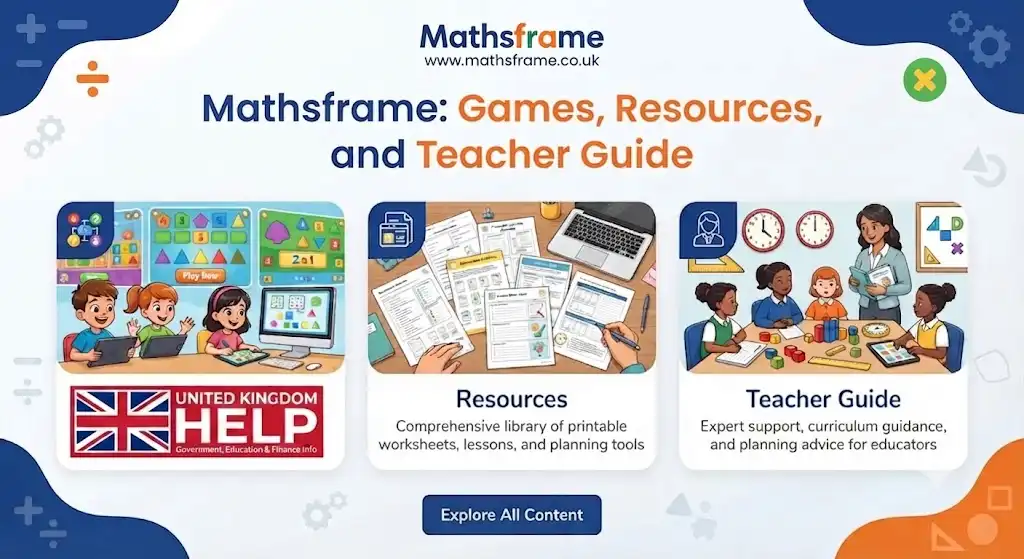
Mathsframe is a practical online learning resource designed to help primary pupils strengthen their maths skills through Mathsframe games, interactive activities, worksheets and assessment practice. If you are looking for an engaging way to support times tables, number facts, fractions, measurement, geometry and other curriculum areas, it can provide focused practice alongside normal classroom teaching. It is for teachers is most effective when an activity is selected for a clear learning objective, followed by discussion and written practice. Rather than replacing teaching, Mathsframe games can reinforce concepts, build fluency and give pupils opportunities to practise skills in an interactive format.Visit our Homepage for more information.
What is Mathsframe?
Mathsframe is an online maths learning resource for primary pupils, offering interactive Mathsframe games, practice activities, worksheets and assessment materials linked to curriculum skills. It can help children practise number facts, times tables, fractions, measurement and other maths topics in an engaging way. Teachers can use it as short focused practice after teaching a concept, then discuss strategies and check understanding through questions or written tasks. Some activities are available freely, while additional resources may require registration or a licence. For the best results, use it to reinforce teaching rather than replace explanation, reasoning and teacher guidance.
Why teachers use Mathsframe
Mathsframe is particularly useful when the learning goal is already clear. Instead of asking pupils to choose a random game, begin with the mathematical skill that needs rehearsal.
For example, a Year 4 class working on multiplication might spend only a few minutes practising the 6, 7 and 9 times tables. The teacher can then ask pupils to explain how they reached a difficult answer. One pupil may double a known fact, another may use compensation, while another may build the calculation from a related multiplication fact.
That discussion is important because fluency involves more than speed. A mathematically fluent learner needs accuracy, automatic recall, flexibility and the ability to select an efficient method. The supplied source specifically frames fluency around accuracy, automaticity, mental calculation, flexibility and explanation.
A high score can therefore be useful evidence, but it should not be treated as the whole assessment. A child who answers quickly may still struggle to explain the underlying relationship.
What research suggests about digital maths games
The evidence included in the source material provides an important qualification: digital resources tend to be more valuable when teachers actively integrate them into instruction.
A review by Higgins, Xiao and Katsipataki is described as finding positive effects from educational technology, while also highlighting the importance of teacher involvement. The supplied evidence notes that technology used without appropriate guidance can have much weaker effects.
The material also references Wouters and colleagues’ meta-analysis of serious games. Its interpretation is especially relevant to Mathsframe: game-based learning can support learning, but practice-oriented games are better suited to automaticity and fluency than to replacing conceptual teaching.
Byun and Joung’s work is also cited in the source. The supplied summary reports positive effects for digital game-based mathematics learning, particularly in arithmetic and number fluency, with stronger outcomes in some collaborative settings and among younger learners.
The practical lesson is simple: use Mathsframe to reinforce teaching, not to replace it.
A better classroom routine: model, play, pause and explain
One of the strongest approaches described in the supplied material is a four-stage routine:
Model: Introduce the strategy away from the game.
Play: Give pupils a short period of focused practice.
Pause: Stop before the activity becomes passive repetition.
Explain: Ask pupils how they solved one or more questions.
A final revisit later in the week can provide another opportunity for retrieval.
For example, when teaching number bonds, the teacher might first demonstrate making ten. Pupils then play a suitable activity for a few minutes. After stopping, the teacher asks, “Which numbers did you combine first, and why?” The same skill can then appear again during a later starter.
This approach makes the digital activity part of a wider learning sequence rather than the lesson itself. The supplied material recommends essentially this model because the teacher remains responsible for mathematical language, reasoning and misconceptions.
Mathsframe and the UK curriculum
The source describes Mathsframe as covering a broad range of primary mathematics, particularly across Key Stage 2. Areas include number, calculation, fractions, measurement, geometry and statistics, with activities linked to National Curriculum objectives.
The progression can be used deliberately. A learner might first encounter visual representations of fractions, then work with equivalent fractions, followed by increasingly complex fraction operations. Similarly, multiplication facts can later support division because the two operations are mathematically connected.
This is more useful than treating every game as an isolated activity. Teachers should ask:
Those questions turn a game library into a planned teaching resource.
Game categories and areas of practice
Mathsframe activities can be selected according to the mathematical skill being developed. The supplied content identifies number facts, mental maths, fractions and geometry among the major areas, alongside multiplication, mixed operations and time-related activities.
Multiplication and times tables
Times tables are one of the clearest uses for short digital practice. Games can provide repeated recall while the teacher focuses on strategy.
Rather than asking pupils only to memorise 7 × 8, ask whether they can reach the answer using a known fact. For instance, they might double 7 × 4 or calculate 7 × 10 and subtract 7 × 2.
This turns recall into connected mathematical knowledge.
Fractions
Fraction activities can support visual understanding before pupils move towards symbolic calculation. Fraction Wall and Bar Modelling are identified in the source as examples of activities that can help learners connect fractions with visual representations.
A teacher might display equivalent fractions, ask pupils to manipulate representations and then transfer the same relationship to written notation.
Place value
Interactive representations can make place value more visible. A pupil can work with tens and ones, identify digit values or explore how numbers change when a place-value position changes.
Geometry and measurement
Games and interactive tools can provide opportunities to practise properties of shapes, angles, measurements and related vocabulary. The important step is to ask pupils to explain the mathematical relationship rather than simply select an answer.
Mathsframe for Key Stage 2
The source places considerable emphasis on Years 3 to 6. The described content includes number and calculation, fractions, measurement and related areas, with activities becoming more demanding as pupils progress.
A Year 3 learner may use visual fraction representations, while later year groups can encounter equivalent fractions and more advanced operations. Decimal and percentage activities can also help pupils connect different representations of the same quantity.
For example:
25% = 1/4 = 0.25
A useful game should not be the end of this learning. The teacher can ask pupils to explain why those representations are equivalent and where the relationship might appear in a real problem.
Hit the Button and times-table practice
Hit the Button is presented in the source as a fast-paced activity designed to rehearse times tables and related number facts. The material also mentions a Times Tables Speed Test and a Multiplication Tables Check Simulator as useful practice formats for learners preparing for the Year 4 multiplication tables check.
These tools can be useful when the objective is rapid recall. However, teachers should still balance speed work with reasoning.
A sensible routine might be:
Short recall game → explain one strategy → solve a related written question.
This helps prevent pupils from associating mathematics only with speed.
Choosing the right game for the learning objective
The best starting point is the objective, not the game menu.
Suppose the lesson objective is equivalent fractions. A teacher should select an activity that directly supports equivalence rather than simply choosing any fraction game.
If the objective concerns multiplication of two-digit numbers, choose practice that reinforces that particular skill. If the objective is place value, select a game that makes place-value relationships visible.
The source stresses that deliberate selection helps connect the intended curriculum with what actually happens in the classroom.
This is especially important for short activities because a five-minute game can still become wasted time if the mathematical purpose is unclear.
Five checks for genuine maths fluency
When using Mathsframe, teachers can look beyond the score by checking five dimensions:
Accuracy: Is the answer correct?
Automaticity: Can the learner recall the fact without unnecessary effort?
Mental strategy: Does the learner have a useful way to reach the answer?
Flexibility: Can the learner solve it differently when appropriate?
Explanation: Can the learner communicate why the method works?
Imagine a pupil answers 7 × 8 instantly. Ask, “How did you know?” If the pupil can connect the fact to 7 × 4 doubled or another efficient relationship, the teacher has stronger evidence of understanding.
The source similarly warns that a high game score does not necessarily demonstrate flexible fluency and recommends combining digital results with questioning or other evidence.
Worksheets and assessment resources
The supplied material describes more than 300 printable worksheets and assessments alongside the interactive games. These resources can provide a useful bridge from digital practice to paper-based work.
That transition matters because pupils eventually need to demonstrate mathematics without game mechanics, animations or instant feedback.
A teacher might therefore use this sequence:
Game practice → discussion → worksheet → teacher review.
The worksheet can reveal whether pupils can apply the idea away from the screen. It also gives teachers an opportunity to identify learners who require another explanation or more practice.
The source describes progress reporting as useful for identifying broad patterns of engagement and performance, while noting that it should not be treated as a complete replacement for detailed assessment.
Do not rely on the score alone
A digital score is one piece of evidence.
A teacher may notice that several pupils repeatedly perform poorly on a particular skill. That can signal an area worth revisiting. Equally, an unusually high score may need checking if the learner cannot explain the strategy independently.
Try questions such as:
These questions reveal mathematical thinking that a score cannot show.
Interactive Teaching Programs
The source also describes more than 20 free Interactive Teaching Programs, or ITPs, intended for whole-class modelling. These include visual tools such as number grids, line graphs and virtual measuring instruments.
These tools serve a different purpose from a pupil-facing game. Instead of asking every child to practise independently, the teacher can project a visual model and manipulate it while questioning the class.
For example, a number-grid activity can be used to explore patterns in multiples. A line-graph tool can help demonstrate plotting and interpreting data. Virtual rulers, protractors, scales and thermometers can provide demonstrations when physical equipment is limited.
The interactive element also supports formative assessment. A teacher can change a value and ask pupils to predict what will happen before revealing the result. Their answers provide immediate evidence of understanding.
Ready to Progress criteria and Mathsframe
The supplied material connects Maths with the Department for Education’s Ready to Progress approach. The central idea is to map digital practice to the specific mathematical knowledge pupils are expected to secure.
For example, a place-value objective can be reinforced through activities requiring pupils to partition numbers into tens and ones. An equivalent-fractions objective can be supported through matching visual representations such as 1/2 and 2/4.
The key is intentional selection.
A teacher should first identify the relevant curriculum statement, teach it clearly, and then use Maths for targeted rehearsal. This makes the digital activity contribute to progression rather than simply fill spare lesson time.
Virtual manipulatives and the CPA approach
Interactive mathematics resources can also support a Concrete-Pictorial-Abstract progression.
The source describes digital representations such as Dienes blocks, place-value counters and beadstrings. These can help learners explore relationships visually before moving towards formal notation.
Imagine teaching addition with regrouping. A teacher could demonstrate 37 + 25 using virtual place-value counters. Pupils can see ten individual ones being exchanged for one ten before completing the written calculation.
This helps answer the important question behind a procedure: Why does regrouping work?
Digital manipulatives are most valuable when they are used to connect representations, not simply because they look interactive.
Mathsframe for homework
Mathsframe can also form part of a short home-learning routine. The supplied material recommends matching homework games closely with classroom teaching and keeping the activity manageable.
Parents do not need to become maths teachers. A useful role is to ask the child about their thinking.
For example:
“Which question was hardest?”
“What strategy helped?”
“Can you show me another way?”
A ten-minute practice routine may be more productive than a long session that becomes tiring. Repeating a familiar skill during the week can also support spaced practice.
Physical resources can be combined with digital work. Number lines, 100-squares, dice, Numicon or other manipulatives can help children connect screen-based activities with physical mathematical thinking.
Making gamification work without overusing it
Timers, scores, levels and challenges can make practice feel engaging. The source also gives examples of classroom adaptations involving multiplication, number comparison, angles, mental maths, perimeter and personalised quizzes.
However, competition should not become the learning objective.
Some children thrive on leaderboards; others may find public comparison distracting. Teachers can therefore vary the format. Pair work, personal-best challenges and explanation-based rewards can be alternatives to ranking everyone.
It is also worth preparing pupils for assessments that do not provide instant feedback. The source recommends gradually moving from game practice to whiteboard work and then paper-based questions.
Mathsframe compared with other resources
No single platform needs to do everything.
The supplied material discusses combining it with resources such as Times Tables Rock Stars and Topmarks. A dedicated times-table platform may be preferable when the sole goal is rapid multiplication recall, while it can provide a broader mix of fluency and curriculum-linked practice.
A school could therefore assign different roles:
|
Resource purpose |
Suitable approach |
|---|---|
|
Daily times-table recall |
Short retrieval practice |
|
Guided maths practice |
Maths activity linked to the lesson |
|
Whole-class modelling |
Interactive Teaching Program |
|
Paper consolidation |
Worksheet or teacher-created task |
|
Homework |
One focused activity connected to current learning |
The aim is not to collect platforms. It is to give every digital resource a clear instructional job.
Who created Mathsframe?
The supplied material attributes the development of Maths to Ted Burch and describes his background in mathematics and primary education. It states that the platform was developed over an extended period with classroom experience informing its design.
This teacher perspective is presented as part of the reason the platform focuses on curriculum-linked activities and practical classroom use.
When describing any educational platform, however, it is sensible to distinguish between information supplied by the platform or source material and independently verified claims. Teachers should check current provider information before making purchasing or implementation decisions.
Licensing and access
The source describes a mixture of free games and subscription-based resources, with annual individual and whole-school licensing mentioned in the supplied material. It also states that some activities can be saved or printed depending on access.
Because pricing and licence terms can change, schools should verify current costs and exactly what each plan includes before purchasing.
The practical question is not simply “Is it cheap?” but “Will the available resources support the mathematical objectives we actually teach?”
Technical access and HTML5
The supplied material explains that older interactive educational resources sometimes depended on Adobe Flash and that it activities were rebuilt using HTML5 following the end of Flash support.
The purpose of this transition was broader browser compatibility and easier access across modern classroom devices. The source describes use through computers, Chromebooks, iPads and Android tablets without requiring the older browser-plugin model.
For schools, this matters because technical friction can quickly consume lesson time. Browser-based activities are generally easier to incorporate into existing classroom routines when devices and internet access are already available.
A practical Mathsframe lesson plan
A teacher could organise a short lesson sequence like this:
Before the activity: identify the exact mathematical objective and model the required strategy.
During practice: give pupils a short game session with a clear success criterion.
Pause: stop the activity before pupils become focused only on scores.
Question: ask one or two pupils to explain their method.
Transfer: provide a related whiteboard or written question.
Revisit: return to the same skill later in the week.
This structure reflects the central principle running through the supplied material: technology is most useful when it is deliberately connected to teaching, assessment and curriculum progression.
Common mistakes to avoid
Using a game without a learning objective
If pupils cannot explain what mathematical skill they are practising, the activity may have little instructional value.
Treating speed as understanding
Fast answers are useful for fluency, but mathematical understanding also requires reasoning and flexibility.
Leaving pupils on screen for too long
Short, focused practice is easier to connect with teaching than unrestricted game time.
Ignoring misconceptions
A low score is not merely a poor result. It may be a clue that a pupil needs a different representation or explanation.
Using technology instead of direct teaching
Games cannot replace modelling, questioning, discussion and feedback.
Forgetting the paper transition
Pupils eventually need to apply mathematics without the support of game mechanics. Moving from screen to whiteboard and paper can make this transition smoother.
How to get more value from Mathsframe
A strong implementation can follow a few principles:
Frequently Asked Questions
Conclusion
It can be most effective when teachers connect its games and interactive resources to clear learning goals. For teachers seeking games, Mathsframe worksheets, and Mathsframe activities, the best approach is to combine digital practice with teaching, questioning and explanation. This supports maths fluency while helping pupils revisit skills, receive feedback and build confidence. The teacher remains central to checking understanding, addressing misconceptions and guiding meaningful mathematical reasoning.