
Pay Council Tax is an important part of managing household costs in England and Wales. If you have recently moved into a property, whether you rent, own your home, study in the UK or work here, understanding your council tax bill can help you know what you owe, when payments are due and whether you may qualify for a discount or reduction.
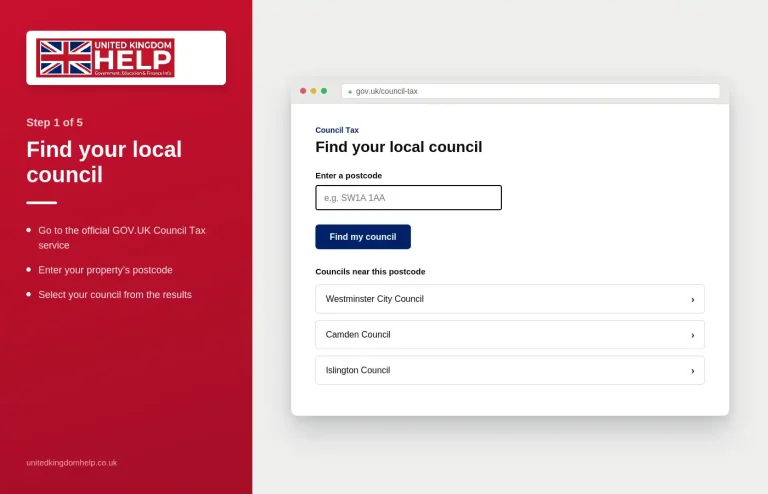
If you want to pay council tax online, the official GOV.UK service makes the process simple. Enter your postcode to find the correct local authority, then use the council’s own payment service to manage your bill. This helps you reach the right council without searching through multiple websites.Visit our Homepage for more information.
Quick answer: To pay council tax online, start with the official GOV.UK payment page, enter your postcode, and follow the link to your local council. Have your Council Tax account or reference details available when completing the transaction.Visit our Homepage for more information.
What Is Council Tax?
Council Tax is a local charge used to help councils fund services in their communities. The amount you owe is linked partly to your property’s valuation band and partly to the rate set by your local authority.
Most people aged 18 or over are potentially responsible for the bill. A standard full bill assumes at least two adults are living in the property. Married couples and partners who live together can be jointly responsible for the amount due.
Your circumstances can change what you actually owe. For example, living alone may qualify you for a 25% reduction, while certain students and other qualifying people may be disregarded when the council works out the charge.
Who Usually Has to Pay?
Responsibility normally depends on who lives in the property and their legal relationship to it. If you have recently moved home, it is important to tell the local authority rather than assuming that your landlord, previous tenant or another household member will update the record for you.
For international residents and students, one point is especially useful: being new to the UK does not automatically mean that Council Tax does not apply. Your liability depends on your circumstances and the property you occupy.
How Is Your Council Tax Bill Calculated?
A major part of the calculation is the property’s council tax band. In England, homes are placed into one of eight bands, from A to H. The Valuation Office Agency bases the English bands on the property’s estimated open-market value on 1 April 1991, rather than its current selling price. Wales uses a different valuation date.
The band does not by itself tell you the exact amount you will pay. Your local authority sets its own annual charge, while the different bands represent proportions of the Band D amount.
|
Band |
England valuation range based on 1991 value |
Proportion of Band D |
|---|---|---|
|
A |
Up to £40,000 |
6/9 |
|
B |
£40,001–£52,000 |
7/9 |
|
C |
£52,001–£68,000 |
8/9 |
|
D |
£68,001–£88,000 |
9/9 |
|
E |
£88,001–£120,000 |
11/9 |
|
F |
£120,001–£160,000 |
13/9 |
|
G |
£160,001–£320,000 |
15/9 |
|
H |
More than £320,000 |
18/9 |
These are the official England valuation ranges and band proportions. Your actual bill is determined by your local authority’s annual charge and any applicable discounts, reductions or premiums.
For context, the average Band D charge in England for 2026–27 is £2,392, including adult social care and parish precepts. This is an average, not a standard amount that every Band D household pays.
How to Check Your Council Tax Band
If you are unsure which band applies to your home, use the official government checker rather than relying on a property listing or an estimate from a third-party website.
You can search using the property’s address or postcode. The same service also provides information about challenging a band if you believe the valuation is incorrect.
Council Tax Band Checker: What You Should Know
Your council tax band checker is useful when:
Remember that the band is not simply today’s market value. In England, the valuation is based on the property’s estimated value at the historical valuation date of 1 April 1991.
How to Pay Council Tax Online
Once you know your valuation band and have received a bill, the next step is choosing how you want to settle the amount. Most councils provide an online payment option, but the exact payment page, account system and available methods depend on your local authority. GOV.UK acts as the starting point for finding the correct council
Step-by-Step: Pay Council Tax Online
1. Find your local council
2. Open the council’s payment service
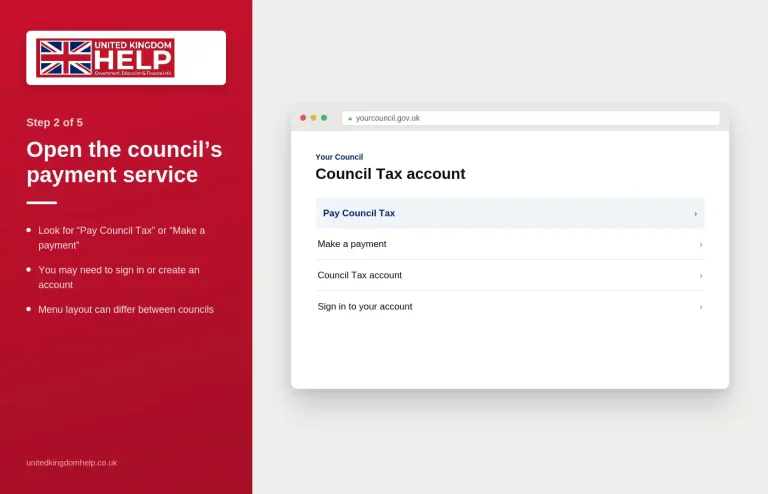
- Look for options such as “Pay Council Tax”, “Make a payment” or “Council Tax account.”
- Some councils may ask you to create or sign in to an online account.
- The exact layout and wording can differ between councils.
3. Keep your Council Tax bill nearby
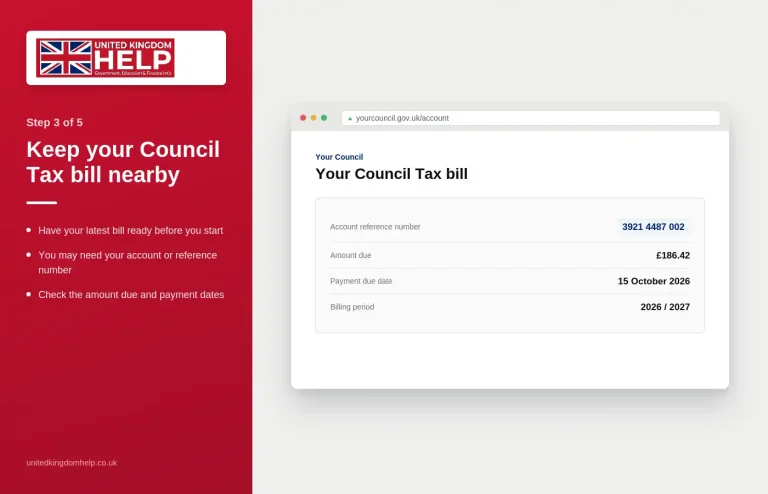
- Have your latest bill ready before you start.
- You may need your Council Tax account or reference number.
- Check the amount due and payment dates so you make the correct payment.
4. Choose how you want to pay
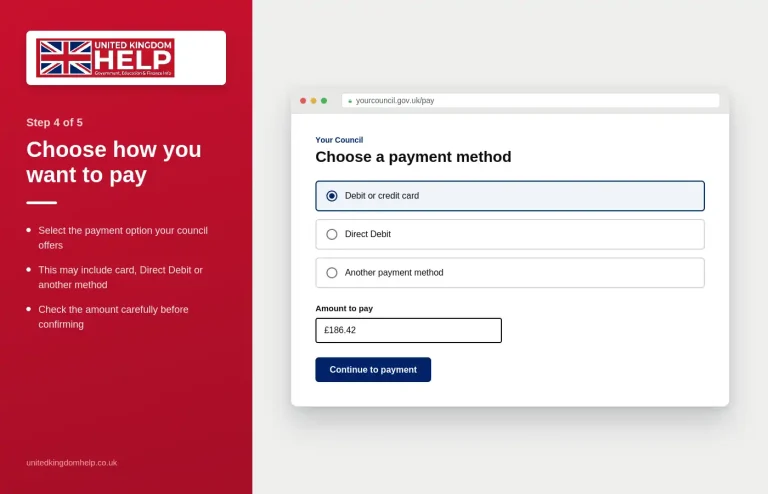
- Select the payment option offered by your council.
- This may include a debit card, Direct Debit or another approved method.
- Follow the instructions carefully and check the amount before confirming.
5. Save your payment confirmation
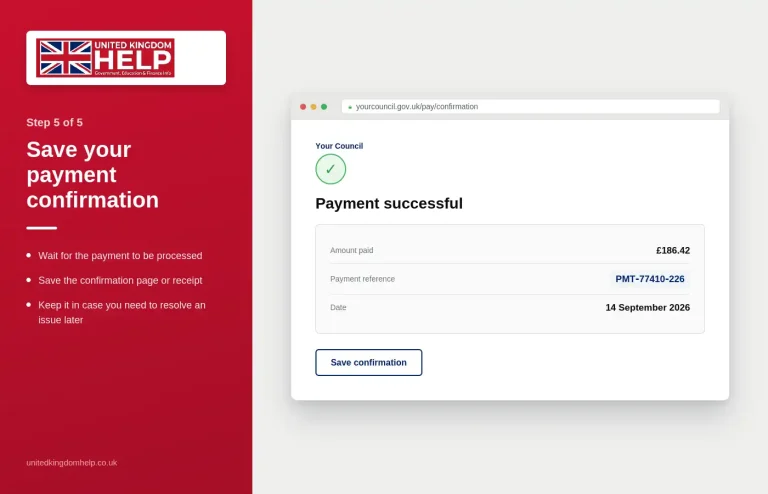
Keeping proof of payment can make it easier to resolve any issue with your council later.
Wait for the payment to be successfully processed.
Save the confirmation page, receipt or transaction reference if provided.
Council Tax Login: What You Need
A council tax login is not necessarily the same across every local authority. Councils use their own account systems, so there is no single nationwide Council Tax username and password.
Your council account may allow you to:
If you cannot access your online account, use the password-reset or account-recovery option provided by your local council. Avoid entering your details into an unofficial website.
Important: GOV.UK helps you find the correct local authority, but your council normally manages your individual bill and account.
What Is Council Tax Reduction?
Council Tax Reduction is different from simply checking your band. It is a form of support that can reduce the amount you have to pay if you meet the eligibility requirements.
Your local council operates the scheme, so the exact rules can vary depending on where you live. Eligibility can depend on factors such as household income, savings, benefits, children, other adults in the property and your circumstances. In some cases, eligible households can receive a reduction of up to 100%.
This is particularly worth checking if your household income has fallen or you receive certain benefits. You can apply whether you own your home or rent it, subject to the rules of your local scheme.
Discounts You May Be Able to Claim
Not every household has to pay the full standard amount. Some people are legally disregarded when the council calculates the number of adults in a property.
Examples include certain full-time students, some apprentices, student nurses, people who are severely mentally impaired, qualifying live-in carers and diplomats.
The most familiar discount is the 25% single-person reduction. This can apply when you live alone or when the other people in your home are disregarded for Council Tax purposes. If everyone in the household is disregarded, the bill can generally receive a 50% reduction.
You normally need to apply for a discount or exemption rather than assuming that the council will automatically identify your circumstances.
Students and International Students
Full-time students can be disregarded for Council Tax purposes when they meet the relevant requirements. GOV.UK also states that properties occupied exclusively by qualifying full-time students can be exempt.
This can be particularly important for international students because simply being an overseas student is not the deciding factor. The relevant student-status requirements still need to be met.
If your household contains both students and non-students, do not assume the entire property is automatically exempt. Check the rules and contact the local authority if you are unsure.
Choosing the Right Payment Method
The best option depends on your circumstances and the payment facilities offered by your council.
|
Payment method |
How it works |
Best suited to |
|---|---|---|
|
Online payment |
Make an individual payment through the council website |
One-off payments or clearing an amount due |
|
Direct Debit |
Payments are collected automatically |
People who want regular payments without remembering each date |
|
PayPoint or Payzone |
Pay through participating locations |
People who prefer paying in person |
|
Post Office or other approved services |
Available where listed by the council |
Those who need an alternative payment route |
Not every council offers exactly the same combination of services. Your bill should explain which methods are available for your account.
Can You Spread Council Tax Over 12 Months?
Council Tax is usually divided into 10 monthly instalments, although you can ask your council whether you can spread the cost across 12 months instead. This reduces the amount taken in each instalment, which can make monthly budgeting easier.
If your household budget is tight, contacting the council early is usually better than waiting until a payment has already been missed. You can ask about changing the payment arrangement or whether you qualify for Council Tax Reduction.
What Happens If You Miss a Payment?
Missing an instalment does not mean you should ignore the bill. Contact your local council as soon as possible if you are struggling to keep up.
According to GOV.UK, a council normally sends a reminder giving you 7 days to bring the missed payment up to date. If you do not pay within that period, you can become liable for the full year’s Council Tax. Further missed payments can lead to additional recovery action.
You can receive a maximum of two reminder notices during a financial year, which runs from 1 April to 31 March.
If You Cannot Afford the Bill
Do not wait for enforcement action before asking for help.
Your council may be able to:
GOV.UK specifically advises people who are behind with payments to contact their council as soon as possible.
Moving Home? Update Your Council Tax Details
Moving house can change which authority is responsible for your bill. Tell your current council when you leave and contact the new council after moving into your next property.
Do not assume that changing your address with another organisation automatically updates your Council Tax record.
You may need to provide:
Keeping these records accurate matters because discounts and liability are based partly on who lives at the property and their circumstances.
Discounts and Reductions
The amount on your Council Tax bill isn’t necessarily the final amount you have to pay. Your household circumstances, property adaptations and living arrangements can affect your liability.
Before making a payment, check whether you qualify for any support. This can prevent you from paying more than necessary and is particularly important for students, people living alone and households on a low income.
Discount
Single-person discount
If you are the only qualifying adult living in your home, you may be entitled to a 25% discount on the Council Tax bill.
The key word is qualifying. Some adults are legally disregarded when the council works out who lives in the property for Council Tax purposes.
For example, a household containing one person who counts for Council Tax and another adult who is disregarded may still qualify for the single-person reduction.
You normally need to apply through your local authority rather than simply deducting the discount yourself.
Full-time students
Students can have different Council Tax treatment from ordinary adult residents. Full-time students who meet the relevant requirements are generally disregarded when the council calculates the bill.
A property occupied entirely by qualifying full-time students may be exempt from Council Tax. However, a mixed household can be treated differently, so don’t assume that having one student in a property automatically removes the entire bill.
International students should check their position with their local authority, especially if they share accommodation with non-students.
Council Tax Reduction
If your income is low or you receive certain benefits, you may be able to apply for council tax reduction. This is separate from the standard discounts described above and is normally administered by your local council.
The amount of support depends on your circumstances and the rules used by your council. Some schemes can reduce a bill substantially, potentially covering all of the amount for people who meet the relevant conditions.
Don’t assume that receiving Universal Credit automatically means your Council Tax bill disappears. Council Tax Reduction is administered locally and normally requires an application.
Empty Homes and Second Properties
Owning an empty property does not automatically mean the Council Tax bill disappears. In England, you will usually still have to pay, although your local authority may offer a discount in certain circumstances.
Long-term empty properties can also face an additional premium. In England, councils can apply an empty-home premium after a property has been empty for at least one year, subject to the applicable rules and exceptions.
Second homes can also be subject to additional charges in areas where the council has adopted the relevant powers. From April 2025, councils in England can apply a premium of up to 100% on second homes, subject to statutory exceptions.
The rules can be different depending on the property and your circumstances, so check with the relevant local authority before assuming that an empty or second property is exempt.
Some Empty Properties Can Be Exempt
There are circumstances where an unoccupied property may not be subject to Council Tax. Examples include certain properties left empty following a death, properties where the former resident has moved permanently into residential care, and some repossessed or legally uninhabitable homes.
Eligibility is specific, and you may need to apply or provide evidence to your council.
Keep Your Council Tax Records Organised
A small amount of organisation can prevent problems later. Keep your latest bill, payment confirmations, account reference and correspondence from the council together.
It is also sensible to check your bank statement after setting up a new payment arrangement. If an expected payment does not appear, contact the council rather than assuming that the arrangement is active.
For renters, keep a copy of your tenancy agreement as well. It can help establish when you became responsible for the property, although liability itself is determined under Council Tax rules rather than simply by what a tenancy agreement says.
A Useful Payment Checklist
Before you make a payment or update your account, have these details ready:
This preparation makes it easier to complete the correct process without entering information into an unofficial payment page.
Urgent Council Tax Payment Action Plan
If your payment is due, overdue, or you have received a reminder, act as soon as possible rather than ignoring the notice.
The key point: if you are already behind, contacting your council today is generally better than waiting for the debt to increase.
Common Council Tax Mistakes to Avoid
Even a straightforward Council Tax account can become difficult if information is out of date or a payment is missed. These are some of the most common problems to watch for.
Ignoring a missed instalment
A missed payment should not be treated as something that will automatically disappear. Check the reminder and contact the council promptly.
Paying on the wrong website
Search results can contain unofficial websites that look similar to government or council services. Start with GOV.UK and follow the link to your local authority.
Assuming everyone receives the same bill
Council Tax depends on the property band, local authority and applicable charges. Discounts, reductions and exemptions can also affect the final amount.
Forgetting to report a change
Moving home, another adult joining the household or someone leaving can affect your liability or eligibility for a discount.
Continuing a discount after circumstances change
A discount must continue to meet its conditions. Tell the council if your circumstances change rather than assuming the previous reduction remains valid.
Assuming an empty property is automatically exempt
Empty and second properties can still attract Council Tax, and different rules can apply depending on why a property is empty and how long it has been unoccupied.
Failing to check the bill
Take a few minutes to review the amount, instalment dates and property details when your bill arrives. Contact the council if something appears incorrect.
Quick Council Tax Checklist
Use this checklist when managing your account:
Frequently Asked Questions
Conclusion
Managing Council Tax becomes much easier when you know which council is responsible, understand your property band and keep your account information up to date.
The safest approach is to use GOV.UK to find the correct local authority, then follow that council’s instructions for payments, discounts and account changes. If money is tight, do not wait until the situation becomes more serious. Contact the council, ask about available support and check whether council tax reduction could apply.
Read more